A Sub-1-Second WooCommerce Storefront — Without Leaving Woo
Keep WooCommerce as your battle-tested e-commerce backend, replace the frontend with a blazing-fast Next.js, Nuxt, or Astro storefront. ISR caching, edge rendering, sub-1s LCP, native-app-like UX. Full WooCommerce feature parity. Built for stores chasing the next ceiling.
Headless Discovery Call
Tell us about your store — strategy call within 48 hours.
When Your WooCommerce Frontend Has Become the Ceiling
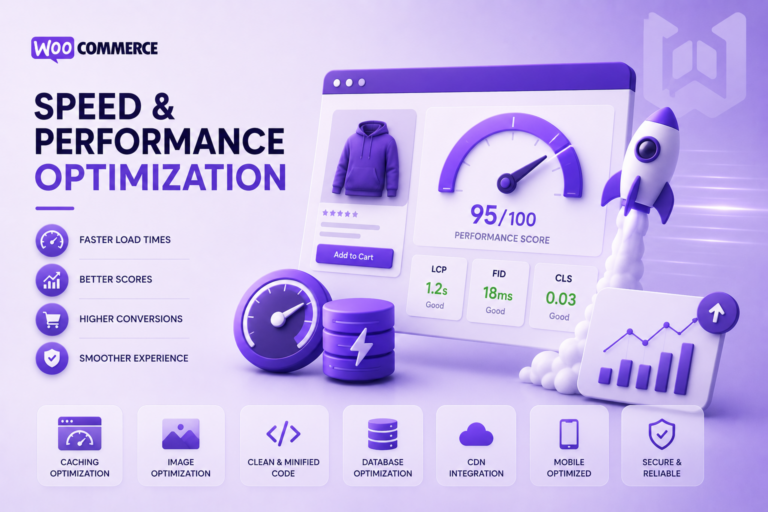
Traditional WooCommerce themes — even well-optimised ones — hit a performance ceiling around 1.5-2s LCP on mobile. For stores where every additional 100ms costs measurable revenue (high-AOV, paid-traffic-heavy, mobile-first), the next ceiling requires a fundamentally different architecture: headless. We keep WooCommerce as the proven e-commerce engine (catalogue, pricing, inventory, orders, customers, payments, plugins) and replace only the frontend with a Next.js / Nuxt / Astro storefront that renders at the edge, caches aggressively via ISR, and feels like a native app. Sub-1-second LCP, 99+ PageSpeed, and conversion lifts of 25-50% are realistic targets.
See Past Headless BuildsWhat Headless WooCommerce Actually Means (Decomposed)
The term “headless commerce” gets used loosely. Here is what we specifically mean and ship:
The Backend (WooCommerce) Stays the Same
WordPress + WooCommerce continues to manage: product catalogue (with variations, custom fields, attributes), inventory, pricing rules, coupons, customers, orders, payments, subscriptions, memberships, B2B pricing, taxes, shipping, email transactional flow, plugins, admin UI, and all your existing integrations (ERP, accounting, fulfilment, marketing). This is the proven, battle-tested e-commerce engine — we do not replace it.
The Frontend Is Replaced
Instead of WooCommerce themes rendering HTML via PHP on every request, the customer-facing storefront is a Next.js (or Nuxt, or Astro) application that fetches data from WooCommerce via REST/GraphQL and renders pages either at build time (SSG), incrementally on-demand (ISR), or per-request at the edge (SSR/edge). The end customer never touches the WordPress server for browsing — they hit the edge CDN and get back fully-rendered HTML in milliseconds.
The Two Layers Talk via API
WooCommerce exposes its data via three main APIs: WooCommerce REST API (for admin operations and most product/customer/order data), WooCommerce Store API (a customer-facing API designed for headless storefronts — cart, checkout, products), and optionally WPGraphQL + WooGraphQL (for stores preferring GraphQL). We typically use Store API + REST for most reads, with custom REST endpoints filling any gaps.
The Three Reasons Stores Go Headless (And Two Reasons They Should Not)
Reasons to Go Headless
- Performance ceiling. Traditional WooCommerce can hit 1.5-2s LCP with optimisation. Headless can hit sub-1s. For high-AOV, paid-traffic-heavy stores, the conversion lift from that gap is significant — typically 20-40%.
- Global reach. Customers in distant regions feel the latency of a centralised WordPress server. Edge rendering eliminates this — sub-50ms TTFB worldwide regardless of where customers are.
- Composable architecture. Mixing best-of-breed tools (Algolia for search, Sanity for CMS content, Shopify for buy-buttons elsewhere, custom personalisation) is easier when the frontend is decoupled.
Reasons NOT to Go Headless
- No in-house JS engineering. Headless adds a Next.js codebase to maintain. If you do not have (or will not hire) a developer who can own that codebase, you will end up dependent on the agency that built it indefinitely.
- Marketing-team-driven editing of complex pages. Traditional WordPress with Gutenberg or a page builder is genuinely easier for non-developers to edit. Headless can support good marketing editing, but it takes more setup.
The Business Case for Headless WooCommerce
For a store doing $2M/year with a 2% conversion rate, a 30% conversion lift (achievable with a well-built headless storefront) means $600K of additional revenue annually. The headless build cost (typically $12K-$25K) pays back in 1-3 months. Plus the speed gains improve SEO, paid traffic ROAS, and brand perception simultaneously.
For a store doing $200K/year, the same percentage lift is $60K of additional revenue. The build cost still pays back in 6-12 months. The math gets steadily worse below $500K/year revenue, which is roughly the threshold where we recommend traditional optimisation over a headless rebuild.
A Production-Grade Headless WooCommerce Workflow
Architecture-first, performance-obsessed, full feature parity.
Strategy & Stack
Next.js vs. Nuxt vs. Astro decision, API approach (REST + Store API vs. WPGraphQL), hosting (Vercel vs. Netlify vs. self-hosted).
Architecture
Data fetching strategy, ISR + on-demand revalidation, cart/checkout flow, customer auth, payment integration.
Design & UX
Mobile-first design (or work from your existing Figma). PWA shell, native-app interactions, instant page transitions.
Build
Frontend in Next.js/Nuxt/Astro. WooCommerce backend tuned for headless (REST/GraphQL, JWT auth, custom endpoints).
QA + Beta
Full feature-parity QA — every WooCommerce flow verified. Beta with friendly users, performance + accessibility audit.
Launch + 90d Support
Production deploy at the edge, ISR warmed, 90 days of free support as edge cases hit scale.
The Headless WooCommerce Tech Stack We Build
Frontend Frameworks
- Next.js 14+ with App Router — our default for serious e-commerce frontends. Best ISR support, best React server components story, biggest ecosystem.
- Nuxt 3+ — strong Vue-based alternative. Excellent if your team is Vue-first.
- Astro 4+ — best for content-heavy, mostly-static stores where most pages are not highly interactive. Smallest JS bundles.
- Remix — occasional choice for stores prioritising progressive enhancement and form-driven UX.
Data Layer
- WooCommerce REST API — primary read API for products, categories, customers.
- WooCommerce Store API — cart, checkout, customer session.
- WPGraphQL + WooGraphQL — for stores preferring a GraphQL layer.
- Custom REST endpoints — built per project to expose data the standard APIs do not (subscription state, member tier, B2B price for current customer, etc.).
- JWT auth via WordPress JWT plugin — for customer auth across the API surface.
Caching Strategy
- ISR (Incremental Static Regeneration) — pages are statically generated and revalidated on a schedule or on-demand via webhook from WooCommerce.
- SSG (Static Site Generation) — for purely-static pages (blog, about, FAQ).
- SSR (Server-Side Rendering) — for pages that need per-request data (cart, account, checkout).
- Edge caching — Cloudflare or Vercel edge cache for ISR pages.
- Stale-while-revalidate — serve cached data while fetching fresh data in the background.
- Webhook-driven revalidation — WooCommerce fires a webhook on product/price/stock change → Next.js revalidates the specific affected pages within seconds.
Hosting Architecture
- Frontend: Vercel (default), Netlify, Cloudflare Pages, or self-hosted Node on AWS/GCP.
- Backend (WooCommerce): Kinsta, WP Engine, Pressable, Cloudways, RunCloud — protected by Cloudflare and not directly exposed to customer traffic.
- Images: Vercel Image Optimization, BunnyCDN Image Optimizer, or Cloudflare Image Resizing.
- CDN: Vercel/Netlify built-in edge network, or Cloudflare in front for additional control.
Observability
- Sentry — error tracking on frontend and backend.
- Vercel Analytics / Netlify Analytics — real-user Web Vitals monitoring.
- Logtail / Axiom — structured log aggregation.
- Uptime monitoring — Better Stack, Pingdom, or UptimeRobot.
A Complete Headless WooCommerce Stack
Frontend + backend tuned together. Full feature parity. Production-grade observability.
Headless WooCommerce Done Right Is Rare
Plenty of agencies promise it. Few have shipped sub-1s LCP storefronts at WooCommerce-store scale.
Sub-1s LCP
Aggressive ISR + edge rendering + critical CSS + image optimisation = the fastest WooCommerce stores possible.
Full Feature Parity
Every WooCommerce feature works — subscriptions, memberships, B2B pricing, multi-currency, coupons.
Headless Checkout
WooCommerce Store API + Stripe Elements for a checkout that stays on your headless frontend.
Production-Tested
Sentry error tracking, Vercel Analytics, structured logging — observability built in.
90-Day Support
Headless edge cases surface as traffic scales. Three months of free support included.
Edge-First
Storefront runs on Vercel/Netlify/Cloudflare edge — sub-50ms global TTFB regardless of customer location.
Who Hires Us for Headless WooCommerce
D2C Brands at the Performance Ceiling
Established D2C brands ($2M-$30M/year) whose traditional WooCommerce theme has been optimised as far as possible (PageSpeed 90+) but who want the next ceiling — sub-1s LCP, native-app-feeling mobile UX, and the conversion gains that come with both. Most headless engagements are this profile.
Global Brands Serving Distributed Audiences
Brands selling internationally where customer latency from a single-region WordPress origin server hurts conversion. Edge rendering on Vercel/Cloudflare delivers consistent sub-50ms TTFB worldwide.
Funded E-commerce Startups Choosing Modern Architecture from Day One
Well-funded startups who want a modern, future-proof architecture from launch rather than rebuilding in year 2. Headless makes sense here when the team has React/Vue capacity in-house.
Stores Migrating Off Shopify Hydrogen / BigCommerce
Brands who tried Shopify Hydrogen or BigCommerce headless and want WooCommerce’s flexibility + plugin ecosystem with the same performance profile. We migrate the frontend approach to Next.js + WooCommerce.
Headless WooCommerce vs. Traditional WooCommerce vs. Shopify Hydrogen
When does headless make sense — and when does it not?
| Feature | Headless WooCommerce | Traditional WooCommerce | Shopify Hydrogen |
|---|---|---|---|
| Typical LCP | <1s | 1.5-3s | <1s |
| PageSpeed mobile | 99+ | 85-95 | 95+ |
| Source code ownership | 100% | 100% | Limited |
| Initial build cost | $10-30K | $2.5-7K | $15-50K |
| Recurring platform fees | $20-200 | $0-50 | $2.3K+/mo |
| Plugin ecosystem | Full Woo | Full Woo | Limited |
| Development team requirements | React+WP | WP only | React |
| Customisation depth | Unlimited | Unlimited | High |
| Marketing-team self-edit | ~ | Full | ~ |
| Best for store size | $1M+/yr | Any | $10M+/yr |
We shipped a Next.js headless storefront on top of WooCommerce. PageSpeed mobile is 99/100, LCP is 0.7s. Conversion rate jumped 41% in the first 60 days and our mobile bounce rate dropped from 64% to 38%. The investment paid for itself in 4 months.
Headless Storefront Builds from $9,999
Fixed pricing. Scope depends on storefront complexity, design depth, and feature parity required.
Standard headless storefront: $9,999–$18,000. Complex (subs, memberships, B2B, multi-region): $20K-$50K.
- Free strategy + architecture call
- Next.js, Nuxt, or Astro frontend
- Full WooCommerce feature parity
- ISR + on-demand revalidation
- Edge rendering (Vercel/Netlify/Cloudflare)
- PWA shell + app-like UX
- Headless checkout via WC Store API
- 90 days of free post-launch support
What Is and Is Not Included in a Headless WooCommerce Build
Always included: framework selection, full architecture, custom frontend in Next.js/Nuxt/Astro, complete WooCommerce feature parity for the core flows (catalogue, search, cart, checkout, account, order management), ISR + edge rendering, PWA shell, headless checkout via Store API, backend tuning (custom REST endpoints, JWT auth), observability setup (Sentry, analytics), staging environment, beta cohort, and 90 days of free post-launch support.
Often available as add-ons: WooCommerce Subscriptions / Memberships full integration, B2B pricing, multi-region with hreflang, multi-currency, advanced personalisation, A/B testing infrastructure, custom CMS layer (Sanity, Contentful) for marketing content, mobile app shell (React Native or Capacitor wrapping the PWA), advanced search (Algolia, Typesense), recommendation engine.
Not included unless scoped: brand identity work, photography, content creation, ongoing maintenance beyond 90 days (covered by Care Plans), paid traffic management, third-party service costs (Vercel/Netlify hosting, Sentry, Algolia).
Common Plugin Compatibility in Headless
- Compatible (work via API): WooCommerce Subscriptions, WooCommerce Memberships, Stripe, WooPayments, Klaviyo, Mailchimp, ActiveCampaign, FacetWP (with custom integration), Yotpo, Loox, Judge.me, WPML, Polylang, MultiCurrency, ACF, RankMath/Yoast (for schema generation).
- Partially compatible: Plugins that mostly use shortcodes or admin UI continue to work in WP admin; their frontend output needs rebuilding in your Next.js code.
- Not compatible: Plugins that hard-couple to specific themes or page builders, plugins that only output via PHP templates, plugins with no API surface. We audit your plugin list during discovery and flag what needs replacing.
Headless WooCommerce — Frequently Asked
Common questions before commissioning a headless build.
Discuss Your Headless WooCommerce Project
Tell us about your store, your team, and your performance targets. Strategy call within 48 hours.